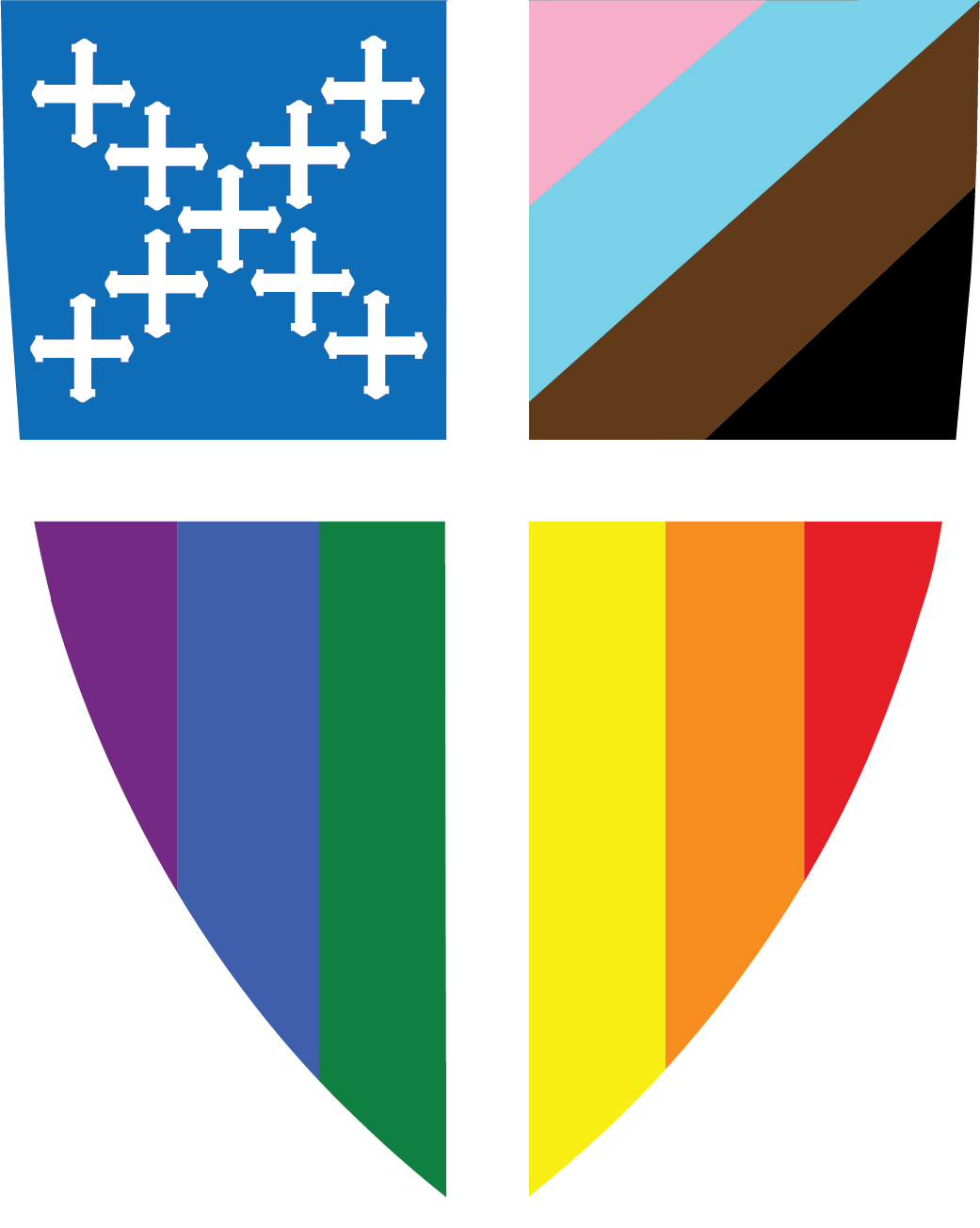
The Episcopal Church Pride Shield — free for congregational use
What this shield is
The Episcopal Church's standard shield — nine crosses on a blue field, a red cross on white — overlaid with the Progress Pride flag. It is the church's official visual signal of its commitment to LGBTQ+ inclusion, available freely for any congregation to use.
Using it is not a neutral act. That is partly the point.
In 2026, The Episcopal Church marks fifty years since General Convention declared that LGBTQ+ people have a full and equal claim to the love, acceptance, and pastoral care of the church. That was 1976. It was not the end of the argument. It was the beginning of a long, contested, still-unfinished reckoning with what the church says it believes and what actually happens on Sunday morning.
Fifty years of this work
In 1974, Louie Crew founded IntegrityUSA with a single goal: full inclusion of LGBTQ+ people in The Episcopal Church. Two years later, General Convention passed resolutions affirming that LGBTQ+ people are children of God with a full and equal claim on the church's pastoral care, and that they are entitled to equal protection under the law.
In the decades since, the church has opened ordination to LGBTQ+ people at every level of ministry. It has authorized rites for blessing same-sex unions and, eventually, for celebrating same-sex marriages. It has built a body of resolutions that, taken together, constitute one of the strongest institutional commitments to LGBTQ+ inclusion in mainline Protestantism.
The people who did that work did not do it easily. There were votes that were close. There were bishops who dissented. There were parishes that left. The church that now publicly celebrates this history was shaped by decades of advocacy from queer Episcopalians and their allies who stayed when staying was costly, and who kept asking for more.
The gap between the shield and the nave
The Episcopal Church is officially fully affirming. That is true. It is also true that individual parishes still make LGBTQ+ people feel unwelcome, invisible, or conditional. Rectors exercise discretion in ways that cost people their sense of safety. Parish cultures communicate things that no resolution has addressed.
The national position and the local experience are not the same thing. Most communicators working in parishes know this. The shield on your website and the culture on Sunday morning can be in genuine tension, and the people most likely to notice that tension are the ones you most need to trust you.
This is not an indictment. It is a description of where many congregations actually are, and it is the reason the tools on this page matter. Posting the shield is a claim. It is worth asking, as you make it, what you are prepared to back it up with.
Tools from the Office of Communication
The Episcopal Church's Office of Communication has built several practical resources congregations can use now. They are free, well-made, and ready for parishes that want to make their commitment visible.
Pride Shield
The shield in multiple formats, ready to download and use on your website, in print, and on social media. Official, free, no design work required.
Download the shield →Customizable Posts and Cards
Social media graphics and printable cards where you add your congregation's name and information. Available in English, Spanish, and French.
Customize and download →Customizable Pride Videos
Thirty- and sixty-second videos congregations can brand to their own. Add your church's information and share across platforms. English, Spanish, and French.
Customize your video →Liturgical Resources
Liturgies, sermons, and worship materials for congregations doing this work in the context of Sunday practice, not just communications.
Explore liturgies →The full picture
The Episcopal Church's LGBTQ+ hub is a good starting point for anyone who wants to understand the breadth of the church's commitment — its history, its organizations, its ongoing task force work, and the formation resources it has built.
Visit the full LGBTQ+ page at episcopalchurch.org →